Blog
For years, getting found online meant one thing: ranking on Google.
Businesses invested in websites, keywords, blogs, backlinks and traditional SEO strategies to reach people searching for their products and services.
That is still important. But the way people discover businesses has changed.
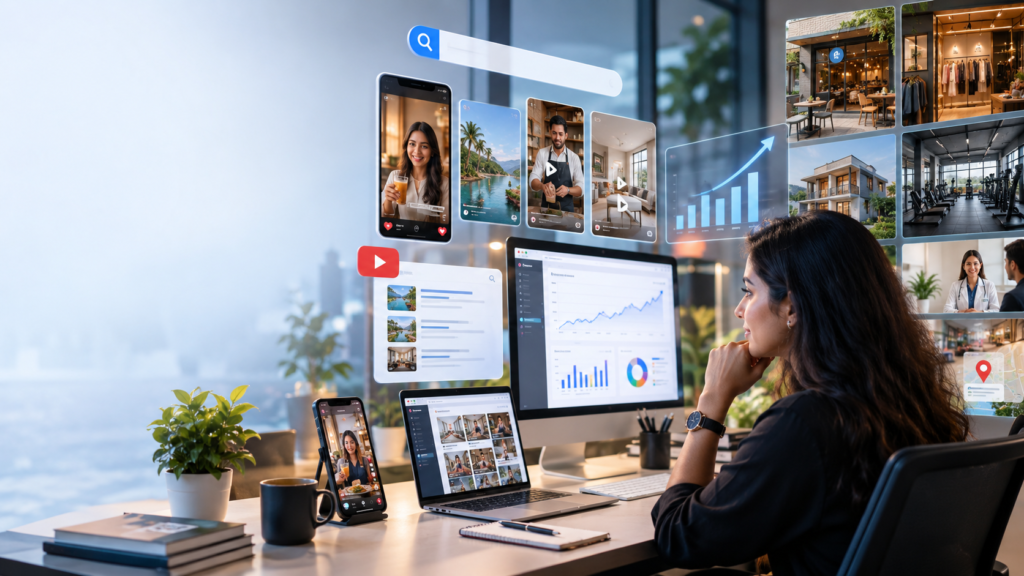
Today, a potential customer might discover a restaurant through an Instagram Reel, search for a service on YouTube, watch a product demonstration before visiting a website, or come across social content while searching on Google.
This shift has made Social Media SEO an increasingly important part of digital marketing.
For businesses in 2026, the question is no longer simply:
“Does my website rank on Google?”
The better question is:
“Can customers find my business wherever they search?”
That includes Google, Instagram, YouTube and other discovery platforms.
What Is Social Media SEO?
Social Media SEO is the process of optimizing social media content so that it can be more easily discovered when people search for relevant topics, products, services or businesses.
It combines traditional SEO thinking with social media content strategy.
Instead of publishing a Reel simply to generate likes or views, businesses can create content around the questions and search terms their potential customers are already using.
For example, an interior design company could create videos around topics such as:
- Best kitchen designs for small homes
- Modern living room interior ideas
- How much does interior design cost?
- Best flooring options for Kerala homes
Similarly, an automobile service centre could create videos answering:
- Why is my car AC not cooling?
- When should engine oil be changed?
- Why does my steering vibrate?
- What causes poor car mileage?
These aren’t simply content ideas.
They represent search intent.
When businesses consistently answer real customer questions through useful video content, social media becomes more than an engagement platform. It becomes a discovery channel.
Why Social Media Is Becoming Part of Search
Search behaviour has expanded beyond traditional search engines.
People want quick answers, visual demonstrations, real experiences and easily understandable explanations.
Imagine someone planning to redesign their living room.
They could search Google.
But they might also open Instagram and search for:
“modern living room Kerala”
or go to YouTube and search:
“small living room interior ideas.”
A potential customer looking for a café may want to see the ambience and food before deciding where to visit.
Someone searching for a digital marketing agency may first watch its Reels, portfolio videos or client work.
The customer’s journey is increasingly spread across multiple platforms.
That means businesses need to think beyond simply ranking a website.
They need to build searchable digital visibility.
Instagram Reels Are More Than Entertainment
Instagram Reels are often treated as short-lived social content.
Create a Reel. Post it. Get some views. Move on to the next one.
That approach misses a bigger opportunity.
A well-planned Reel can answer a specific customer question, demonstrate expertise, showcase a product or service and introduce a business to people who have never followed the account.
For businesses, that makes Reels useful at different stages of the customer journey.
Instead of creating only promotional Reels…
A construction company doesn’t need every video to say:
“Contact us for your dream home.”
It could create:
“3 mistakes to avoid before concreting your roof.”
A curtain shop could create:
“Curtains vs blinds: Which is better for your bedroom?”
A car service centre could publish:
“3 signs your car battery needs replacement.”
And a study-abroad consultancy could answer:
“What is APS for studying in Germany?”
This type of content matches what potential customers genuinely want to know.
That is where Instagram Reels SEO and content strategy begin working together.
How to Optimize Instagram Reels for Search
Good Reel optimization starts before the video is uploaded.
1. Choose One Search Topic
Every Reel should have one clear subject.
Instead of:
“Our latest interior project”
consider:
“Modern Kitchen Interior Design for a Kerala Home.”
The second version gives both the audience and the platform much more context.
2. Use Keywords Naturally in the Video
If your Reel is about home construction costs, actually discuss home construction costs in the video.
Don’t create unrelated content and simply add keywords afterward.
The content itself should satisfy the search intent.
3. Write Search-Friendly Captions
Your caption should clearly explain what the Reel is about.
Instead of:
“Another beautiful project completed ”
try:
“Looking for modern kitchen interior ideas? Here’s how we designed a functional kitchen with better storage and efficient use of space.”
The second caption provides much stronger context.
4. Add Relevant Location Context
For local businesses, location matters.
Use location naturally when it is relevant:
Digital marketing agency in Thodupuzha
Interior designers in Kochi
Car service centre in Muvattupuzha
Curtain shop in Thodupuzha
This can help connect your content with locally relevant searches.
5. Don't Sacrifice Quality for Keywords
Keywords cannot rescue boring content.
The opening seconds still need to create curiosity.
The video should provide value.
And viewers should have a reason to continue watching.
Social Media SEO works best when search relevance and engaging content work together.
YouTube Is a Powerful Search Platform for Businesses
YouTube has one major advantage for businesses:
People often visit YouTube specifically because they want to learn something.
They search for reviews, tutorials, comparisons, explanations, demonstrations and solutions to problems.
That creates an excellent opportunity for businesses to demonstrate expertise.
A cookware company could create:
“How to Choose the Right Non-Stick Frying Pan.”
A hospital could publish:
“What Causes Frequent Back Pain?”
An architect could explain:
“Flat Roof vs Sloped Roof: Which Is Better?”
A digital marketing agency could create:
“How Much Should a Small Business Spend on Social Media Marketing?”
These videos can continue attracting relevant viewers long after they are published.
How YouTube SEO Works
YouTube SEO isn’t about stuffing dozens of keywords into tags.
The goal is to help YouTube and viewers clearly understand what the video is about while creating something people actually want to watch.
Optimize the Video Title
Use a clear title based on what someone might search.
Weak:
“Our New Video Is Here!”
Better:
“5 Instagram Reel Ideas for Local Businesses in 2026”
Write a Useful Description
Explain what the viewer will learn and naturally include the primary topic.
For example:
“Looking for Instagram Reel ideas for your business? In this video, we explain five Reel formats local businesses can use to increase visibility, engagement and customer enquiries.”
Create a Strong Thumbnail
SEO can generate an impression.
The thumbnail helps earn the click.
Keep thumbnail text short and visually clear.
For example:
GET MORE REEL VIEWS
or
5 REEL IDEAS
Keep People Watching
A searchable title may help someone discover a video, but the content needs to deliver what was promised.
Avoid unnecessarily long introductions.
Start with the problem.
Provide the value.
Show examples.
Keep the pacing engaging.
The combination of relevance + viewer satisfaction is far more valuable than keyword stuffing.
Can Instagram Reels and YouTube Videos Appear on Google?
This is one of the biggest reasons businesses should start thinking about video and social content as part of their broader SEO strategy.
Google can surface video content in several areas of its ecosystem, and social and video posts can also contribute to a brand’s discoverability beyond the social platform itself.
That changes how businesses should think about content.
One piece of content isn’t necessarily restricted to one platform.
A strong video topic could become:
Instagram Reel → YouTube Short → Full YouTube Video → Blog Article → Google Business Profile content → Social posts
Instead of constantly creating disconnected content, businesses can build a search-focused content ecosystem around topics their customers care about.
Video SEO vs Traditional SEO
Traditional SEO and Video SEO shouldn’t compete with each other.
They should support each other.
Traditional SEO helps pages, websites and written content become discoverable.
Video SEO helps video content become understandable, searchable and discoverable.
Social Media SEO extends this idea to social platforms.
A strong digital strategy combines all three.
For example, Listen Bytes could publish a blog about:
“How Video Marketing Helps Local Businesses Grow.”
That topic could then become:
- A long-form SEO blog
- A YouTube video
- Three Instagram Reels
- A carousel
- A Google Business Profile post
- Short-form videos for YouTube Shorts
One core topic becomes multiple searchable assets.
The New Customer Journey
Consider how someone might choose an interior designer.
Step 1 – Discovery
They see an Instagram Reel showing a completed home.
Step 2 – Research
They visit the company’s Instagram profile and watch more projects.
Step 3 – Search
They search the company on Google.
Step 4 – Validation
They check Google reviews, the website and YouTube videos.
Step 5 – Action
They call, WhatsApp or submit an enquiry.
No single platform created the conversion.
The combination did.
This is why modern digital marketing needs to connect:
Social Media + Video + Search + Website + Local Presence
Social Media SEO for Local Businesses
This strategy can be especially valuable for local businesses.
Imagine you run a restaurant in Kochi.
Instead of publishing only attractive food photographs, you could create content around searches such as:
Best family restaurant in Kochi
Best biryani in Kochi
Dinner places in Kochi
Restaurant for birthday celebration in Kochi
The same approach applies to salons, clinics, architects, car service centres, jewellery stores, educational institutions and retail shops.
Create content around the questions people ask before they become customers.
7 Practical Social Media SEO Tips for Businesses
1. Start With Customer Questions
Ask your sales team:
“What questions do customers repeatedly ask?”
Those questions are your content ideas.
2. Create Searchable Video Titles
Replace vague creative titles with clear, intent-driven ones.
3. Mention the Main Topic Early
Don’t make viewers wait 20 seconds to understand what the video is about.
4. Create Original, Useful Content
Share your expertise, experience, demonstrations, comparisons, case studies and real projects.
5. Think Local
If your customers come from a particular location, create genuinely useful content for that market.
6. Repurpose Strategically
Don’t simply upload exactly the same piece everywhere.
Adapt one core idea for each platform.
7. Measure Business Results
Views are useful, but they aren’t the final goal.
Track:
- Search visibility
- Website visits
- Profile visits
- Watch time
- Calls
- Messages
- Leads
- Enquiries
- Conversions
The best-performing video isn’t always the one with the most views.
Sometimes a video with 5,000 highly relevant views can generate more business than one with 500,000 irrelevant views.
Is Social Media Replacing Traditional SEO?
No.
A better way to understand the shift is:
SEO is expanding.
Your website still matters.
Google Search still matters.
Blogs still matter.
But customers now discover and research businesses through multiple content formats and platforms.
Businesses that connect these channels can build a stronger digital presence than businesses depending on a single platform.
What Should Businesses Do in 2026?
Stop treating SEO, social media and video production as completely separate activities.
Start with the customer.
What are they searching for?
What problems do they have?
What questions do they ask before purchasing?
What would they prefer to see demonstrated rather than read?
Build your content strategy around those answers.
A good SEO article can inspire a video.
A good video can inspire multiple Reels.
A frequently asked customer question can become an entire content series.
That’s how businesses can turn content production into a long-term digital asset rather than a never-ending posting schedule.
Final Thoughts
Social media isn’t replacing Google.
But search is no longer confined to one search box.
Customers discover businesses through Google results, Instagram Reels, YouTube videos, maps, websites, reviews and recommendations.
That’s why Social Media SEO matters.
Businesses that create useful, searchable and engaging content have more opportunities to appear throughout the customer’s discovery journey.
And video plays a major role in making that happen.
At Listen Bytes, we combine video production, social media marketing, SEO and digital strategy to help businesses create content that doesn’t just look good—it has a purpose.
Because the future of digital marketing isn’t simply about posting more.
It’s about creating content people can find, watch, trust and act on.
Frequently Asked Questions
1. What is Social Media SEO?
Social Media SEO is the practice of optimizing social content so people can more easily discover it when searching for relevant topics, products, services or businesses on social platforms and, where eligible, through broader search experiences.
2. Can Instagram Reels help SEO?
Instagram Reels can strengthen a brand’s overall discoverability when they focus on relevant topics and customer search intent. Social posts from platforms such as Instagram can also be surfaced and measured through Google’s search ecosystem.
3. What is Video SEO?
Video SEO is the process of optimizing video topics, titles, descriptions, presentation and related signals to improve the chances of relevant audiences discovering the content through platforms such as YouTube and Google.
4. How can businesses optimize YouTube videos for search?
Start with topics people genuinely search for. Create clear titles and descriptions, compelling thumbnails and videos that satisfy the viewer’s intent. Engagement and content quality are also important factors in YouTube discovery.
5. Is YouTube SEO important for local businesses?
Yes. Local businesses can use YouTube to answer customer questions, demonstrate services, showcase projects and build trust before a potential customer contacts them.
6. Does traditional SEO still matter in 2026?
Absolutely. Websites and traditional SEO remain fundamental. Social Media SEO and Video SEO should complement traditional SEO rather than replace it.
7. Should every business invest in video content?
Not every business needs the same volume or type of video, but businesses selling products, services, expertise or experiences can often use video effectively to explain, demonstrate and build trust.